
The crater was formed during the Nectarian period, which dates back to 3.85 billion years and is one of the oldest time periods in the Moon's history, the team, including researchers from the Physical Research Laboratory and Indian Space Research Organisation (ISRO), Ahmedabad, said.

Here is the timeline of the moon mission as undertaken by the Indian Space Research Organisation.

"The receiver is kept on. Hoping for a successful awakening for another set of assignments! Else, it will forever stay there as India's lunar ambassador," it said.

The Chandrayaan-2 spacecraft is expected to reach the moon's orbit on August 20 and land on lunar surface on September 7.

Chandrayaan 3 follows the Chandrayaan 2 mission which did not achieve the desired soft landing on the surface of the moon in 2019, disappointing the scientists.

The spacecraft will now prepare for separation of the lander module -- comprising the lander and rover -- from the propulsion module.
"Progressively, you can imagine that it becomes that much more difficult, with each passing hour, the available power on the battery gets drained out, and there won't be anything left for it to power and operate", an ISRO official said.

He noted that Chandrayaan-3 will be inserted into the lunar transfer trajectory after the orbit raising manoeuvres.

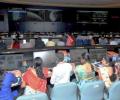
People gathered in educational institutions, offices, city squares and religious places to watch the Indian Space Research Organisation's live telecast of Chandrayaan-3's final descent to the uncharted surface of the lunar south pole.
The Vikram Moon Lander, named after the father of India's space mission Vikram Sarabhai on his birth centenary year, is scheduled to touch the lunar surface near its south pole on September 7 about 1.55 am.

The space agency had got support from the entire nation, despite it losing communication with the lander ahead of the touchdown, with people from all walks of life praising ISRO and its scientists for the achievement.
Mainstream American newspapers, many of which had been sceptical of India's space mission and sometimes even made fun of it through cartoons, noted the great Indian achievement.
'You can observe a lot of things from space.' 'Another thing is communication, in real time, especially in war-like situations.' 'During Operation Sindoor, we could play our part well.'

All spacecraft parameters are normal, the Bengaluru headquartered space agency said after the maneuver on the spacecraft.
ISRO has said once the Lunar night falls, there would be no sunlight for the lander to generate power for its working and also it was not designed to operate in the heavy cold temperature of Moon during the phase.

Rajasthan Sports Minister Ashok Chandna made the slip hours before the touchdown by Chandrayaan's lander on the lunar surface - an unmanned landing eagerly anticipated across the country.

Almost 33 years to the day after his journey to the lunar surface, the inflight coverall jacket, he wore on his mission to the Moon and back in Apollo 11, was sold for $2,772,500 at Sotheby's in New York City.

This incredible stockpile includes nearly every photo taken my astronauts during the missions.
The nine-second de-orbiting or retro-orbiting manoeuvre was executed at 3.42 am using the onboard propulsion system.

Luna-25 may land on the lunar surface earlier than Chandrayaan-3.

China's first moon rover is back to work after a "nap" and has succeeded in sending back the first images of the national flags on itself and the lander, space authorities said on Sunday.
'ISRO takes a very cautious approach.' 'After reaching the moon, the orbit has to be brought down from a single elliptical orbit to a circular orbit while simultaneously ensuring the stability of Chandrayaan 3 and the health parameters of the lander and rover.'

So, if ISRO is able to revive them as the Sun rises on the Moon again, information that is derived from experiments that could once again be conducted by the Chandrayaan-3 payloads would be a "bonus".

The ISRO chief further said that the ISRO is ready to fulfill the vision put forth by Prime Minister Narendra Modi.

China's first lunar rover on Saturday successfully landed on the moon, making the communist giant one of three world powers to make a "soft landing" as part of an ambitious programme that aims to put a Chinese astronaut on the moon.
"Already, orbiter is in space and it should do an excellent job of mapping," Nair said.

Beresheet was developed by SpaceIL and Israel Aerospace Industries. If the mission had been completed successfully, Israel would have been the fourth country, after the Soviet Union, the United States and China, to land a spacecraft on the moon.

ISRO Chairman S Somanath had recently said the most critical part of the landing will be the process of reducing the velocity of the lander from 30 km height to the final landing, and the ability to reorient the spacecraft from horizontal to vertical direction. "This is the trick we have to play here," he said.

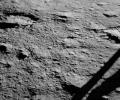
The picture of Moon was taken by Chandrayaan-2's LI4 Camera from an altitude of about 2,650 km from the lunar surface.

The landing on the moon near the South Pole, an uncharted territory so far, would be on September 6 or 7, Sivan told reporters, as the Indian space agency is all set to embark on its most complex mission.

The UAE was set to create history as the first Arab country and the fourth globally to land a spacecraft on the moon had the Emirati-built moon explorer Rashid Rover made a successful landing on the lunar surface.
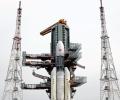
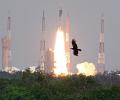
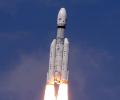
India's second mission to the moon will be launched on Monday at 2.43 pm after its initial launch on July 15 was called off owing to a "technical glitch."

China's first lunar probe on Sunday successfully separated from the lander and left deep traces on its loose soil, hours after the communist giant carried out the world's first soft landing on the lunar surface in nearly 40 years.
The lessons learned from the failure of Chandrayaan-2 contributed to the success of India's third lunar mission, former space scientist with the Indian Space Research Organisation (ISRO) Nambi Narayanan said, after the successful touchdown of the 'Vikram' lander on the lunar South Pole.
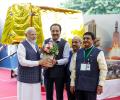
August 23, the day the Chandrayaan-3 lander touched down on the lunar surface, would be celebrated as 'National Space Day'.

The mission has three modules - Orbiter, Lander (Vikram) and Rover (Pragyan)

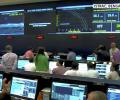
Hours before Chandrayaan-2's 'Vikram' module's proposed soft landing on the Lunar surface, Indian Space Research Organisation chairman K Sivan said on Friday things are progressing as per plan for the much-awaited event.
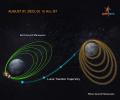
The ISRO had said it would attempt softlanding on the lunar surface on August 23.

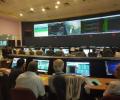
"It is going to be the most complex mission ever undertaken by ISRO. It is going to take place between July 9 and 16, this year," Sivan said, addressing scientists from the Mission Control Centre.

'All possible efforts are being made to establish communication with (the) lander,' the ISRO further said in a tweet.
